Quantum Theory Group in Palermo

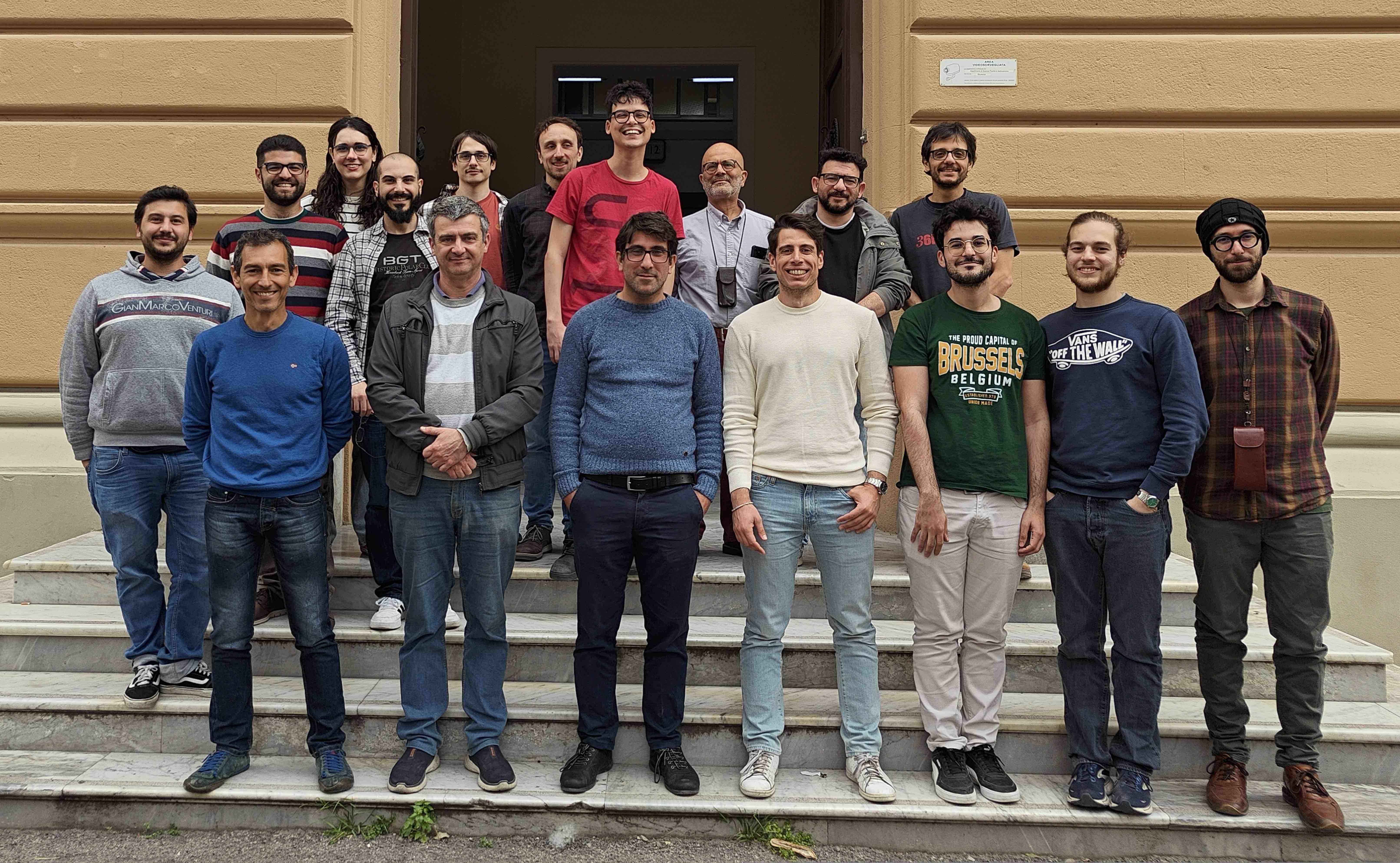
We are a large team, based in the Department of Physics and Chemistry at University of Palermo, exploring the theory of quantum systems and processes.

We address frontier questions in the engineering, control, characterisation and exploitations of quantum states and resources. The expertise of the members of our group spans a large range of topics, from Quantum Optics to Condensed Matter and Statistical Physics, from Quantum Information Processing to Open System Dynamics and Artificial Intelligence. We also enjoy exploring the intricacies of the foundations of quantum mechanics from an information theoretic standpoint. Image
A key aim of our research is the development of theoretical frameworks of prompt experimental translation to understand the interplay between quantum resources, non-equilibrium physics, and control.

While pursuing these goals, we interact with some of the leading experimental teams addressing photonics, optomechanics, cold atom, and semiconductor-based platforms. Get in touch with us if you are interested in our research and to explore potentials for collaborations!
Latest News

Papers, Projetcs and …

Efficient classical training of model-free quantum photonic reservoir

Model-independent estimation of the properties of quantum states is a central challenge in quantum technologies, as experimental imperfections, drifts, and imprecise models of the actual quantum dynamics inevitably hinder accurate reconstructions. Here, we introduce a training strategy for photonic quantum extreme learning machines in which both the learning stage and the optimization of the measurement settings are performed entirely with classical light, while inference is carried out on genuinely quantum states. The protocol is based on the identity between the normalized output intensities following the evolution of coherent states through a linear optical reservoir, and the output statistics obtained with separable input quantum states. Building on this correspondence, we implemented a model-free, gradient-based optimization of the reservoir measurement projection directly on experimental data, without relying on a prior model of the device transformation. We experimentally show that the resulting classical-to-quantum transfer enables accurate reconstruction of single-qubit Pauli observables for previously unseen single-photon states, and extends to the estimation of a two-qubit entanglement witness for arbitrary bipartite states. Beyond demonstrating a qualitatively distinct form of out-of-distribution generalization across the classical-to-quantum boundary, our results identify a practical route to fast, adaptive, and resource-efficient training of photonic quantum learning devices.

Average Equilibration Time for Gaussian Unitary Ensemble Hamiltonians

Understanding equilibration times in closed quantum systems is essential for characterising their approach to equilibrium. Chaotic many-body systems are paradigmatic in this context: they are expected to thermalise according to the eigenstate thermalisation hypothesis and exhibit spectral properties well described by random matrix theory (RMT). While RMT successfully captures spectral correlations, its ability to provide quantitative predictions for equilibration timescales has remained largely unexplored. Here, we study equilibration within RMT using the framework of equilibration as dephasing, focusing on closed systems whose Hamiltonians are drawn from the Gaussian unitary ensemble (GUE). We derive an analytical expression that approximates the average equilibration time of the GUE and show that it is independent of both the initial state and the choice of observable, a consequence of the rotational invariance of the GUE. Numerical simulations confirm our analytical expression and demonstrate that our approximation is in close agreement with the true average equilibration time of the GUE. We find that the equilibration time decreases with system size and vanishes in the thermodynamic limit. This unphysical result indicates that the true equilibration timescale of realistic chaotic many-body systems must be dominated by physical features not captured by random matrix ensembles – the GUE in particular.